
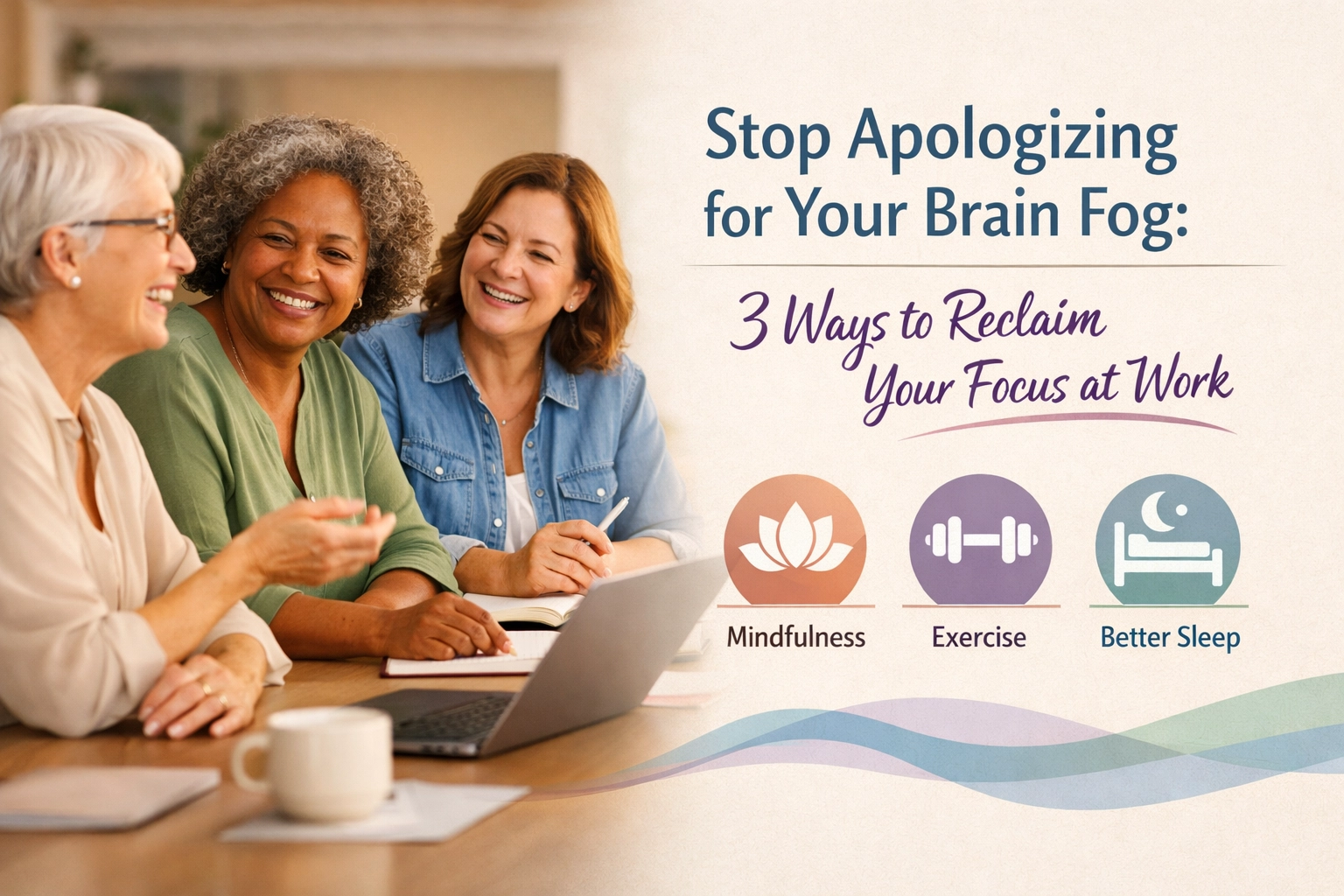
You’re in the middle of a high-stakes presentation. You’ve prepared for weeks. You know the data like the back of your hand. Then, suddenly, it happens. You reach for a word, a simple, common word, and it’s gone. It’s not just misplaced; it’s seemingly deleted from your hard drive.
Your heart starts to race. You feel that familiar heat rising up your neck. You give a nervous laugh and say those words we’ve all used as a shield: "I’m so sorry, I’m just having a total 'senior moment.' My brain is mush today!"
Stop right there.
If you are a professional woman between the ages of 40 and 58, what you’re experiencing isn’t a "senior moment," and it certainly isn't a sign that you’re losing your edge. It’s brain fog, a hallmark symptom of the menopausal transition. And here is the most important thing you’ll read today: You do not owe anyone an apology for your hormones.
At the Menopause Education Center, we believe that understanding the "why" behind your symptoms is the first step toward reclaiming your confidence. You aren't "failing" at your job; you are navigating a massive biological shift.
Here is how to stop the apology tour and start reclaiming your focus using three practical, evidence-based strategies.
The Science: Why Your Brain Feels Like It's in a Cloud
Before we dive into the "how," let’s talk about the "why." Brain fog isn't just in your head, well, it is, but it’s physiological, not psychological.
Estrogen is like high-octane fuel for the female brain. It helps regulate glucose metabolism (how your brain gets energy) and supports the areas responsible for memory and executive function. When estrogen levels begin to fluctuate and eventually drop during perimenopause and menopause, your brain effectively has to learn how to run on a different kind of fuel.
Research suggests that up to 60% of women in midlife report difficulty concentrating or issues with memory. You are not alone, and you are definitely not "crazy."

1. Hack Your Cognitive Load: Break Complex Tasks Into "Micro-Wins"
When you’re dealing with brain fog, a massive "To-Do" list looks less like a plan and more like a threat. When your brain is already working overtime to manage hormonal shifts, staring at a project labeled "Q3 Strategy Presentation" can trigger a freeze response.
The fix? Micro-tasking.
According to research, the brain struggles to prioritize when it feels overwhelmed, leading to that "stuck" feeling. Instead of trying to tackle an entire mountain, break it down into tiny, manageable steps that require very little "startup" energy.
- The Old Way: Put "Finish Marketing Report" on your calendar for 2:00 PM.
- The New Way: Break it down into three 15-minute bursts:
- Draft the outline (15 mins).
- Find the three key data points for the revenue slide (15 mins).
- Write the executive summary (15 mins).
By focusing on one small aspect at a time, you minimize the "cognitive load", the amount of information your working memory has to hold at once. Completing these small steps builds dopamine, which restores a sense of control and gives you the momentum to keep going.
2. Use the "Pattern Interrupt": Quick Resets to Regain Clarity
If you find yourself staring at your screen for twenty minutes without typing a single word, your brain is stuck in a loop. You can’t "white-knuckle" your way out of brain fog. You need a pattern interrupt.
Small, physical interventions can shift your mind out of a foggy state by grounding you in the present moment. Think of these as a "reboot" for your internal operating system.
- Focused Breathing: When stress hits, your cortisol levels spike, which only makes brain fog worse. Taking sixty seconds for "box breathing" (inhale for 4, hold for 4, exhale for 4, hold for 4) signals to your nervous system that you are safe, allowing your prefrontal cortex, the part of the brain that thinks clearly, to come back online.
- The Two-Minute Stretch: Don't just sit there. Stand up, reach for the ceiling, and twist your torso. Physical movement increases blood flow to the brain and can break the "fogginess" caused by prolonged sitting.
- The Environment Shift: If you’re working from home or in an office where you can step away, go outside for three minutes. Fresh air and a change in visual stimuli (looking at trees instead of pixels) can reset your focus almost instantly.

3. Protect Your Foundation: Prioritize Sleep and Boundaries
You can have the best productivity hacks in the world, but if you aren’t sleeping, your brain fog will win every time.
Sleep is when your brain does its "housekeeping." It flushes out toxins and consolidates memories. Unfortunately, menopause often brings night sweats and insomnia, creating a vicious cycle of fatigue and mental clutter.
To reclaim your focus at work, you have to be militant about your recovery. This isn't "self-care", it’s professional maintenance.
- Establish a "Shutdown" Ritual: Stop checking emails at least 90 minutes before bed. The blue light and the stress of a late-night "ping" from a boss can keep your brain in a high-beta state, making deep sleep impossible.
- Take Real Breaks: Prolonged work without breaks causes mental fatigue. Try the Pomodoro technique: 25 minutes of deep focus followed by a 5-minute break where you do not look at a screen.
- Advocate for Your Needs: If you find that your brain fog is most intense in the mornings, see if you can shift your "deep work" to the afternoon, or vice-versa. Understanding your new internal rhythm is key. If you're looking for ways to bring this conversation to your workplace, check out our Business Partnership resources to see how employers can better support these transitions.
Ending the "Apology Tour"
Why do we apologize for brain fog? We don't apologize for having a cold. We don't apologize if we have to wear glasses to see the screen. So why do we feel the need to say "sorry" for a natural, biological transition that affects half the population?
When you apologize for your symptoms, you inadvertently send a message that you are less capable. You aren't. You are a professional with decades of experience who is currently navigating a temporary physiological hurdle.
Try these "Apology Alternatives" in your next meeting:
- Instead of: "I'm so sorry, I'm having such a brain-fart today."
- Try: "Give me just a second to pull that specific word… anyway, moving on to the data…"
- Instead of: "Sorry I'm so slow, menopause is killing my focus."
- Try: "I’m taking a more methodical approach to this project to ensure we hit every detail. I’ll have the update for you by Friday."

You Don’t Have to Navigate This Alone
The transition into postmenopause is one of the most significant shifts in a person's life. It shouldn't be something you have to hide or feel ashamed of, especially not in the workplace where your experience and leadership are needed most.
At the Menopause Education Center, we’re dedicated to providing the evidence-based education you need to stay in the driver's seat of your career and your health. Whether you're looking for live and on-demand webinars to learn more about managing symptoms or you want to see how your company can become a more menopause-friendly environment through our opportunity deck, we are here to help.
Your Call to Action:
Tomorrow, when that "fog" rolls in, don't apologize. Instead, stand up, take three deep breaths, and break your next task into three tiny pieces. You’ve got this.
Frequently Asked Questions
Is brain fog a permanent part of menopause?
No. For most people, the cognitive "glitches" of perimenopause and menopause stabilize as the brain adapts to lower estrogen levels in postmenopause.
Should I talk to my boss about my brain fog?
This is a personal choice. However, many find that framing it as a "temporary health transition" while offering solutions (like shifted hours or written recaps of meetings) helps maintain professional standing while getting the support they need.
Where can I find more resources?
Check out our full range of menopause classes to dive deeper into the science of the transition and find community support.